

VOLUME 6 • ISSUE 2 • June 2026
A New Journey Begins
Honpa Hongwanjiʻs new president reflects on leadership, community and humility
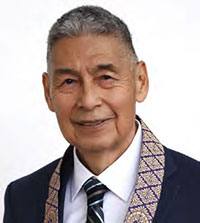
BY MICHAEL MUNEKIYO
PRESIDENT, HONPA HONGWANJI MISSION OF HAWAIʻI
Having started my term this past February, I am quickly finding my footing and adjusting my daily routine to include the tasks required of the Hawaiʻi Kyodan President.
It is definitely a work in progress, but I am getting the hang of it.
That said, I thank our Past President, Dr. Warren Tamamoto, for leading the Honpa Hongwanji Mission of Hawaiʻi over the past six years.
I imagine he ascended a similar learning curve. In my observation, his embrace of leadership and care of the Hawaiʻi Kyodan is a model to follow.
His calm and thoughtful management style deserves our deepest respect and heartfelt gratitude. I look forward to working with Dr. Tamamoto as the transition process continues.
For those of you who may not know me, a quick bio might be in order.
I was born and raised on Maui, where my parents and grandparents were members of Wailuku Hongwanji.
I grew up at Wailuku Hongwanji — my Dharma roots are anchored there.
My wife Lori and I live in Wailuku with our elderly Lhasa Apso.
Our two daughters are out of the house living with their families on Oʻahu and in San Jose, California.
I thought I retired a couple of years ago, but that was merely an illusion.
Where I can, I have been supporting Wailuku Hongwanji, the Lahaina Hongwanji Recovery and Rebuilding Committee, as well as other nonprofits here on Maui. Truth be told, I am an aging and proud Baby Boomer.
Through daily recitation of the Nembutsu, I express gratitude… grateful that my physical and cognitive capacities to be useful are still functional. Yet I realize that uncertainty looms with each tick of the clock.
In my previous working life, I was an urban planner and planning consultant. Being a planner for many years taught me a few good things: respect process, empathize with community, be humble.
After all, a planner’s job does have potential to affect the places in which we live, work and play.
Lessons from my work as a planner will likely come in handy in my role as Hawaiʻi Kyodan President. Respecting process, empathizing with community, being humble; in my opinion, required ingredients for all leaders in a sound organization.
1. Respecting Process
We are often reminded that countless causes and conditions have brought us to our current life circumstance. As we think about it, some of these may be interpreted as random, others more thoughtful and organized.
Planners operate in systems intended to resolve issues and facilitate decision making through a series of carefully laid out process steps meant to consider direct and indirect consequences, both short-term and long-term.
Understandably, even the best-designed process may not yield outcomes satisfactory to all. Nonetheless, it is important that steps taken to address issues and concerns are fair, reasonable and logically sequenced.
2. Empathizing With Community
In day-to-day practical terms, this means taking time to talk story with stakeholders so that we can better understand how they feel about a particular area of concern or actions of an organization.
Feeling what they are feeling – not an easily achievable task, but one worth pursuing.
In the world of planning, encountering opposing points of view on a proposed policy or project is an expectation.
Taking time to talk story with those holding varying viewpoints may not get us to consensus. It will however, give us a sound appreciation of our individual human qualities and preferences.
Not an easy state-of-mind to achieve, but Talking Story with others will help us avoid categorizing positions as “us” or “them.” Empathizing with community helps us better understand that each of our lives are unique and valued.
3. Being Humble
Not much to say here. The concept and related behaviors are recognizable.
However, its practical application is much more difficult as we let our self-centeredness often get in the way.
In the planner’s world that I lived in, we researched, analyzed and presented findings as objectively as possible. As process will allow, we also received comments that often challenged our findings.
Nonetheless, we responded as best we could with respect, without widening disharmony. Even if written comments, phone calls or public meeting testimonies received were often at the “less than friendly” end of the spectrum, we understood that humility was an essential ingredient to point us toward common ground.
Respect, empathy and humility; values that will help us negotiate the challenges and uncertainties of managing the Hawaiʻi Kyodan.
Perhaps equally important, values that convey to our entire sangha that within our Jodo Shinshu tradition, there lies a foundation of compassion and dignity that guides us in how we go about solving problems.