

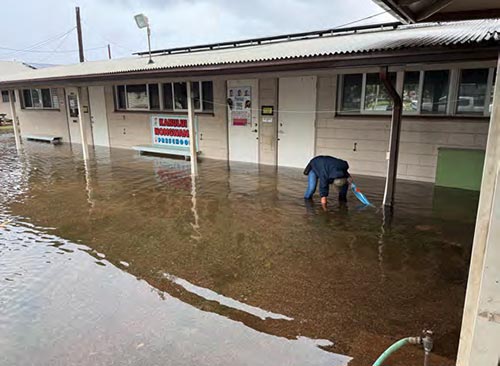
Kahului Hongwanji Mission’s temple, left, sits above the Kitchen and Social Hall, center. Both sustained little to no damage. But at right, floodwaters seeped into the Preschool, where damages are likely to exceed $30,000. Photos courtesy of Wayde Toyama.

VOLUME 6 • ISSUE 2 • June 2026
Record Rainstorms Damage Kahului Preschool
Volunteers, families and supporters quickly mobilize to restore, reopen and plan for the future
BY GAIL S. TAGASHIRA
MANAGING EDITOR KA LEO KĀHEA
The rains that started in Central Maui on Friday, March 13, didn’t seem serious to Carolyn Kaya, but they felt strange: All day long, buckets of water would pour down for a while, then lighten up, then repeat.
The next day, Kahului Hongwanji Mission’s secretary expected a quiet, routine Saturday checking on rummage sale items she had boxed up and stacked near the judo classroom and it was her turn to feed Midnight, the temple’s shy, gray cat.
As she drove the short distance from her Wailuku home along Pu‘unēnē Avenue, water pooled in the streets, but it was passable and the winds were moderate.
She parked in her usual spot in front of the temple, walked around the corner and started to head down the sloping ramp toward the office when she got the surprise of her life.
“I was shocked to see that pond of water and decided to walk around the back to reach the office,” she said. “There was just so much water at the base of the ramp. I had never seen it flood this much.”
She called out to Midnight, but the feral cat, first adopted by former minister Rev. Richard Tennes, was nowhere. Usually, he would cautiously saunter up to sangha members, knowing he would be fed.
Shortly after 8 a.m., with the water levels rising in front of the school, Mrs. Kaya took photos and sent them to Kahului Hongwanji president Wayde Toyama, who quickly called his Dad, Douglas Toyama.
“We’ve had flooding in the past so I wasn’t surprised,” Wayde said. “I figured we could just deal with it and after the water level subsided, we could open the doors on Sunday.”
The Toyamas texted resident minister Rev. Ai Hironaka, who was in his residence, asking if he would check on the ponding around the buildings.
Once Rev. Hironaka sent photos, the Toyamas were on their way from Makawao, expecting the worst.
As they drove, Douglas Toyama suggested setting up the extra sump pump they kept in storage in case of big floods. But even with the second pump, draining the volume of water was slow going once they got started.
They were both taken aback by the sight of the water levels, which had risen to about a foot along the preschool building.
“When we arrived at the temple, I was shocked at how extensive it was,” Wayde said. “I had never seen our property so full of water before. My Dad said it happened once — maybe 30 or 40 years ago — but I don’t remember it happening.”
And yet, just glancing at the lawns and walkways underwater didn’t prepare them for what was inside Kahului Hongwanji Preschool which sustained the most extensive damage of all 30 Honpa Hongwanji temples.
Because Kahului Hongwanji’s property slopes downward — from the temple at the highest point to the preschool at the lowest — floodwaters inundated the classrooms and playground.
Nearly everything in the schoolroom sustained damage — each little chair, the desks, toys, bookshelves and the thick foam carpets where children played, sat and listened to stories. All of it was wet, soiled or broken.
Each mat used by the 27 preschoolers had to be tossed; pressed wood furniture pieces wobbled or collapsed. Some benches outside broke apart. Doors warped and wouldn’t close.
Temple leaders were advised by one restoration company that an environmental specialist should check for mold; one wooden storage room wall appeared weak and needed to be torn down and rebuilt because of mold.
Thankfully, none of the children was around. Two days before the rains, parents were informed that if the weather was stormy, if the Department of Education ordered schools to be closed, then Friday’s classes would be cancelled and spring break would start a day early for the three- to five-year-olds.
Between March 13 until past the Kuhio Day holiday weekend, all students remained at home, much to the chagrin of their parents.
What happened next in the midst of the extensive flooding brought together dozens of people throughout Maui and once again, the indomitable spirit of the island was on display.
Restoration work progressed rapidly and a week later, a semblance of normalcy returned. The Department of Human Services inspected and approved the facility for reopening despite the need for more furniture.
Flooring had been removed, items sanitized and new floors installed, thanks to the tireless efforts of supporters.
Parents breathed a collective sigh of relief. Most children were unaware their classrooms had been flooded, noticing only that they were back together again — except for one little girl who said she missed her friends during the long break.
And even Midnight reappeared, looking no worse than before. He even began befriending more humans.