
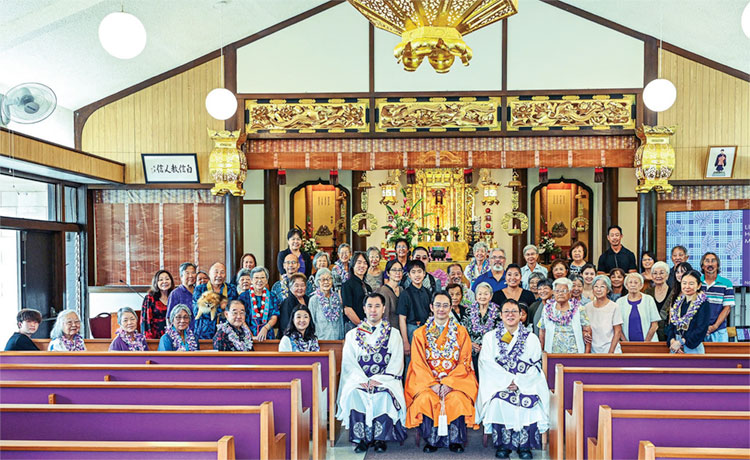
Members and guests at Līhu’e Hongwanji’s 125th Anniversary celebration attended an opening service on Nov. 2, officiated by Bishop Toshiyuki Umitani, center. Rev. Tomo Hojo of West Kauaʻi Hongwanji, seated at left, and Līhu’eʻs resident minister Rev. Shawn Yagi, also presided.

VOLUME 5 • ISSUE 4 • December 2025
A Journey of Nembutsu Remembered and Renewed
Celebrating 125 years, Līhu‘e Hongwanji honored pioneers whose compassion and vision shaped the community
An extraordinary celebration of Līhu‘e Hongwanji Mission’s 125th anniversary took place on Nov. 2, attended by more than 100 guests and members, many of whom were affiliated with the temple for more than 70 years.
The event marked an appreciative, heart-rending reflection on the past, remembering the pioneers who worked tirelessly to spread the Dharma despite hardships and challenges.
Officiated by Bishop Toshiyuki Umitani, the opening service traced the rich history and poignant stories of those who shaped the lives of immigrants and the community.
To prepare for his Dharma message, Bishop Umitani found himself reading about its long history marked by significant events and ministers whose names are recognized in Hawai‘i Hongwanji’s history of ministers.
Before the temple was even established, Rev. Soryu Kagahi visited Kaua‘i in August of 1889 and realized a huge need and desire of immigrants seeking spiritual guidance.
Eleven years later, Rev. Kenyu Arai arrived in December of 1900 to begin the tireless work of building a temple on land donated by Līhu’e Plantation. Three years later, after the temple was completed, he returned to Japan.
For the next 45 years, Rev. Hiseki Miyasaki “truly embodied the pioneering spirit of early Hongwanji ministers,” Bishop Umitani said.
“His 45 years of remarkable service were filled with creativity, dedication and compassion.
“He started Japanese language classes, organized the Fujinkai (women’s association), opened a Sunday School, established the YMBA (the forerunner of the YBA) and even started a kindergarten, 4-H Club, Boy Scouts and a bridal school.”
In those years, ministers traveled to nearby homes, most within 10 miles but some as far as 30 miles either on foot or on horseback, often holding the service at night.
Month after month, Rev. Miyasaki conducted as many as 30 gatherings a month, unwavering in his commitment to spread the Buddha-Dharma.
His years as a Līhu‘e Hongwanji minister included three years of incarceration in Santa Fe Camp from 1942-1945.
“Of course, it was not only Rev. Miyasaki but also many ministers and lay members who worked tirelessly to share the teachings throughout the islands of Hawai‘i,” Bishop Umitani said.
“We remember Yukito Sakai who protected the temple when the property was occupied during the wartime. “We remember Rev. and Mrs. Umemura, whose Sunday School work reached beyond the temple to the state level.
“We remember Rev. Terayama and Seiji Kusato who organized the hoshakai — a service group of retired men and women.
“The list goes on and on.”
The light of the Dharma that each pioneer illuminated has been carried forward. Each had their own story, challenges and contributions that helped shape Līhu‘e Hongwanji into what it is today — a spiritual home where the teachings of Amida Buddha have been taught, shared, practiced and lived.
“For 125 years, the temple has been a place where people shared joy, laughter, solace and comfort,” Bishop Umitani said. “The 125th anniversary is not only a time to celebrate, but it is also a time to reflect on the work that lies ahead.
“How can we ensure that Līhu‘e Hongwanji continues to be a vibrant and meaningful presence for generations to come?
“How can we deepen our understanding of the Dharma and live it in a way that benefits not only ourselves, but all beings?
“We are not alone in this journey.
“With the same spirit of dedication, compassion and wisdom that has carried us to this moment, I am confident we will continue to walk forward together — guided by the light of Amida’s infinite Wisdom and Courage.”
Rev. Shawn Yagi and Temple President Lynne Matsumura organized the historic, joyous program which included music, a catered luncheon and games in the Social Hall.
– Gail S. Tagashira